Symbolism, Visualization and Ritual in
Buddhism, Paganism and Christianity

The mind has several levels, the main distinctions being
- (i) Gross mind
- (ii) Subtle mind and
- (iii) Very subtle or root mind.
The gross level corresponds, more or less, to our waking mind and the subtle level to our dreaming mind. But only the very subtle root mind goes on from life to life to life, so it is this level of the mind that we need to transform to make progress on our spiritual path.
There are a number of ways of producing long term changes to the root mind. One of the easiest to understand is analytical and placement meditation, where we use discursive philosophical reasoning and/or intellectual analysis to generate a realisation of a particular idea. We then attempt to hold this realisation for as long as possible (placement), and mix and imprint it into the deeper and more subtle levels of the mind.
As well as analysis and placement, we can also use intuitive experiences to transform the root mind. The three main ways of accessing intuitive levels of the mind are symbolism, visualisation and ritual. Symbolism may be used on its own, or in combination with visualisation and ritual.Symbolism
The concept of symbolism has two aspects - Representational Symbolism and Evocative Symbolism, though sometimes a representational symbol can, with familiarity, become an evocative symbol.Representational symbols
These are shorthand representations for substances, numbers, instructions etc. Examples are chemical symbols such as Na, Au, Pb for sodium, gold and lead; p for 3.14159, and the warning symbols in road signs. These types of symbols are interpreted by, and affect, the gross levels of our minds, and are used for our normal day-to-day business.Evocative symbols
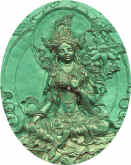
Evocative symbols are interpreted by and affect the more subtle levels of the mind. Evocative symbolism is associated with art, architecture and poetry, especially where there is a spiritual aspect. Examples of evocative symbolism in the visual arts are icons, thangkas, mandalas, stained glass windows and statues of holy beings. Examples in architecture are stupas, mandalic temples, stone circles and the spiritually soaring structures of Gothic cathedrals. Examples in poetry are the 23rd Psalm and the Sadhana of Arya Tara.Evocative symbolism does not use direct representation, reference or explicit analogy. As the symbolist Mallarme said "Don't paint the thing itself, paint the effect that it produces".
Similarly with symbolist poetry. Direct description is avoided because it engages the grosser levels of the mind. Intuitive realisations are produced by indirect allusion and subtle evocation.
Representational symbols may evolve into evocative symbols.
On first meeting with Buddhist teachings, many Westerners ask about the meanings of unfamiliar symbols such as the lotus, wheel, vajra etc. These are explained, and at first understood, intellectually (they are thus representational symbols) .But later, as intellectual understanding of the concepts transform into intuitive realizations, the symbols may become evocative. Merely seeing the symbol may then evoke the associated realization.
Visualization.
Visualization usually begins with representational symbolism. For example, in the Lojong visualization the black smoke and white light represent suffering and happiness. But with practice the understanding may become more deeply intuitive and less intellectual. Presumably the same thing happens as Tantric practitioners gain greater experience of visualizing themselves as the Yidam.Ritual
Ritual is acting out or watching someone else acting out a symbolic role in order to bring about deep changes in one's mind. Rituals may be performed individually, but often involve numbers of practitioners.The theatre may have originated out of pagan Greek religious rituals. For example, ritualised acting out of tragedy was used to produce catharsis in the minds of the audience.
Ritual actions often involve some form of symbolic transformation, purification or gift. Examples are baptism, empowerment, Holy Mass and Tsog offerings.
Other rituals evoke a symbolic journey, and may involve traversing a path through a processional or meditational landscape. Examples are the ritual landscape around Stonehenge in England, and the circumambulation of Mount Kailas in the Himalayas.
- Sean Robsville
See also:
Buddhist Teachings
on the mind, personal relationships, meditation and the spiritual path.Wicca and intuitively resonant Pagan rituals
Hallucinogens
It's no secret that many Westerners have come to Buddhism via use of psychoactive substances (in fact the Buddhist magazine Tricycle once devoted an entire issue to this subject).Visualization to bring the future result into the present path
'....even though we have not yet attained enlightenment, when we practise Secret Mantra we try to prevent ordinary appearances and ordinary conceptions of our environment and instead visualize our surroundings as the mandala of a Deity. In the same way, we prevent ordinary appearance of our body, our enjoyments, and our deeds, and, in their place, generate ourself as a Deity, visualize our enjoyments as those of a Buddha, and practise performing enlightened deeds. By doing such practices, we can attain the resultant state of Buddhahood very rapidly...'Arguments against Buddhism
' ....People get spiritual experiences under the influence of electromagnetic fields such as Transcranial Magnetic Stimulation (TMS), and from psychedelic drugs such as mescalin, LSD, Psilocybe semilanceata and Amanita muscaria. All these transpersonal experiences are simply delusions caused by disruption of the normal electrochemical activity of the neurones.'' ...Yes and No. There's no doubt that people experience other realms of reality under the influence of TMS or psychoactive drugs. In these conditions the functioning of the brain is indeed abnormal. But - you've got to ask yourself - what is the purpose of the normal functioning of the brain? The brain is a device which has evolved by selection of the fittest (not the most truthful) to project the delusion of the inherently-existing self onto the mind. This delusion of a permanent, unchanging self is 'imputed' over the ever-changing transitory collection of biochemical building blocks that makes up the physical aspects of a sentient being. Disruption .... by biochemical or biophysical agents, enables the mind to temporarily push the doors of perception ajar and peek beyond mundane biologically-determined appearances.... '
Evidence for a spiritual dimension of the mind.
Philosophical and scientific evidence that the mental continuum (root mind) is a fundamental and immortal aspect of human existence which cannot be reduced to physical phenomena.Christopher English resource for symbolist art and poetry - An extensive list of links (several pages) to sites dealing with symbolism in art and poetry.